Recovering Sacred Rhythms
Christian Practices
Embrace timeless spiritual disciplines to nurture modern discipleship.
Ancient Practices for a Modern Church
The Christian Practices initiative invites pastors, ministry leaders, and believers to rediscover the historic rhythms of Christian spiritual life. Through practices like the Daily Office, scripture meditation, contemplative prayer, and faithful stewardship, we emphasize spiritual formation, leadership development, and accessible theological learning.
The Christian Practices initiative is a developing effort to help the church rediscover the spiritual practices that have formed disciples for generations. Through prayer, scripture, community, and faithful stewardship, we seek to cultivate spiritually attentive leaders for the renewal of the church. Our mission is to guide individuals and communities in cultivating a deeper connection with God, fostering a transformative journey of faith that is rooted in tradition yet relevant for today’s church.

The Prayers of the Daily Office
Throughout the history of the Church, followers of Jesus have returned again and again to simple rhythms of prayer and Scripture, allowing their lives to be shaped by God’s presence from beginning to end. The Daily Office gathers these rhythms into a steady pattern of Morning Prayer, Noonday Prayer, Evening Prayer, and Compline.
There is something deeply grounding about knowing that you are not alone in prayer. At any given minute, tens of thousands of believers across the world are praying the Daily Office. As morning unfolds across different regions, the Church continues its quiet, steady conversation with God. When you open the Scriptures, when you pause in silence, when you offer your prayers, you are joining a rhythm that is already underway. You are stepping into a global and historic movement of prayer that has never ceased.
The Spiritual Formation Pathway
The Spiritual Formation Pathway is a simple visual framework that draws from historic Christian teaching about prayer, spiritual practices, and the transformation of the heart. It brings together biblical imagery, the rhythms of prayer taught by Jesus, and the classic Christian understanding of spiritual growth found in early Christian writers.
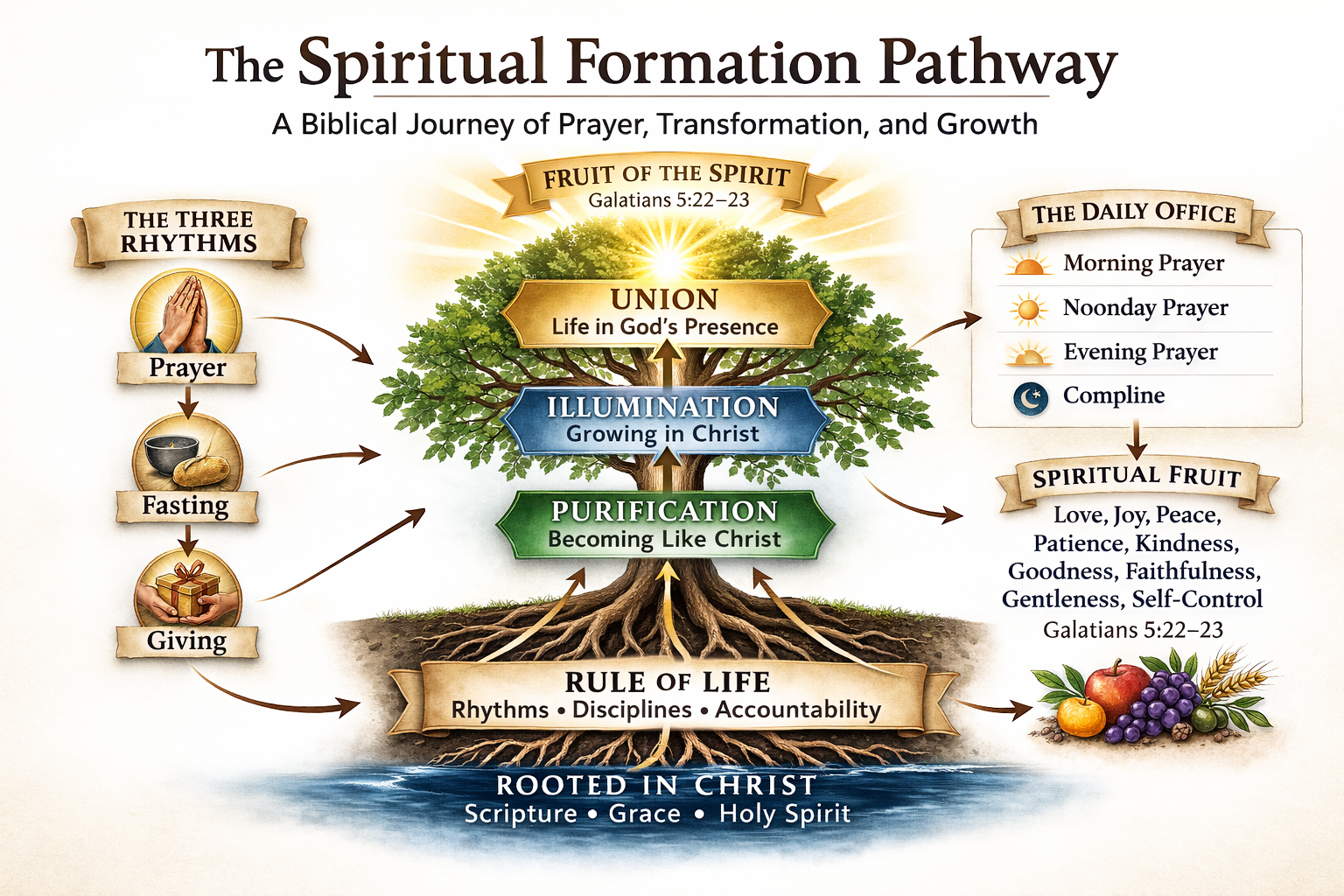
For centuries Christians have understood spiritual growth as a journey shaped by intentional rhythms of prayer and devotion. The Spiritual Formation Pathway illustrates how historic Christian practices help believers grow in their life with God.The image of a tree provides a helpful way to visualize this process.
The Roots: The Rhythms of Christian Life
At the foundation of the spiritual life are three rhythms taught by Jesus in the Sermon on the Mount.
Prayer • Fasting • Giving
These practices anchor the believer’s life in God.
Prayer cultivates communion with God.
Fasting trains the heart in humility and dependence.
Giving expresses love for others and trust in God’s provision.
Together these rhythms nourish the entire life of faith.
The Trunk: A Rule of Life
The trunk of the tree represents a Rule of Life.
A rule of life is simply a pattern of spiritual practices that helps believers remain rooted in Christ. It provides structure for daily rhythms such as prayer, Scripture reading, worship, and acts of generosity.
Rather than being rigid or legalistic, a rule of life creates space for a consistent and sustainable life with God.
The Growth Path: The Journey of Spiritual Formation
As the tree grows upward it reflects the historic path of spiritual growth described by early Christian teachers.
Purification
This stage focuses on turning the heart toward God and allowing Him to reshape our desires and habits.
Illumination
In this stage believers grow in awareness of God’s presence through Scripture, prayer, and reflection.
Union
The final movement describes a life increasingly rooted in communion with God and expressed through love for others.
These movements are not rigid stages but describe the gradual transformation that occurs as believers walk faithfully with God.
The Goal: A Life Formed in Christ
The purpose of spiritual practices is not the practices themselves. Rather, they are means through which God shapes the life of the believer.
As Christians remain rooted in prayer, guided by Scripture, and attentive to God’s presence, their lives are gradually transformed to reflect the character of Christ.
Christian Practices Initiatives
The Christian Practices Initiative is rooted in the formation pattern Jesus teaches in the Sermon on the Mount. Through rhythms of prayer, fasting, generosity, and Scripture, believers grow in humility, love, wisdom, and union with God.
Online Bible Institute
Offering accessible biblical education, the Online Bible Institute provides courses that deepen theological understanding and scriptural knowledge for believers worldwide.
Church Encourager Initiative
Focused on leadership formation, the Church Encourager Initiative mentors ministry leaders through collaborative learning and support networks.
Kingdom Influence Project
Dedicated to contemplative leadership development, the Kingdom Influence Project equips leaders to integrate spiritual practices into their leadership roles.
Daily Spiritual Practice
Engage in daily prayer, scripture reading, and reflection to nurture a consistent spiritual rhythm.
Certificate in Christian Practices
The Certificate in Christian Practices is designed to guide believers into a deeper and more intentional life with God through the historic rhythms of the Christian life.
Virtual Church Spark
Support for pastors and churches seeking renewal through leadership coaching, digital ministry strategies, and practical guidance.
Kingdom Stewardship Initiative
Explore stewardship and discipleship initiatives that encourage living out your faith in everyday life.
Kingdom Encouragers Platform
Connect with others through shared spiritual practices and community support.
Walking the Rhythms of Grace Part 5 — Learning to Live Within the Word
As the rhythm of returning began to take root in my life, it started to change how I engaged Scripture. Before this, much of my interaction with the Bible had been centered on reading for understanding or preparing for teaching. Those are important and necessary, but something new was beginning to emerge. Scripture was no longer just something I studied. It was becoming something I lived within. Instead of moving quickly through passages, I found myself slowing down. Certain words would stay with me. Certain phrases would return throughout the day. The rhythm was creating space not just to read the Word, but to remain with it.
This was a different kind of engagement. It was less about covering ground and more about being formed. I began to notice that when I allowed Scripture to stay with me, it started to shape my thoughts, my responses, and even my awareness of God’s presence in ordinary moments. A verse from the morning would come back in the middle of a conversation. A line from a Psalm would surface in a quiet moment. It was as if the Word was beginning to move with me through the day. I was not just visiting Scripture. I was beginning to dwell in it.
Over time, this led me to be more intentional about how I held onto what I was reading. I wanted a simple way to stay connected to the Word beyond a single moment of reading. Not something complicated or demanding, but something that could help carry the rhythm forward. This is where the seeds of what would later become Daily Psalt Intake began to take shape. It was not born out of a strategy or a plan. It grew out of a desire to remain in the Word in a steady and accessible way. The same was true for what would eventually become Daily Sage Intake and Daily Strength Practices. Each one emerged from the same place, a growing awareness that Scripture was meant to be lived with, not just learned.
Looking back, I can see that this was another important shift in the journey. The Christian practices were no longer just helping me return to God at certain moments. They were beginning to shape how I walked with Him throughout the day. Scripture was no longer confined to a specific time. It was becoming a companion in the rhythm of my life. And once again, I was reminded that this was not about creating something new. It was about learning to live within what had been there all along. The Word was not simply something to read. It was an invitation to remain, to listen, and to be formed over time.
Steve Lawes serves as the lead pastor of Keys Vineyard Church, founder of the Online Bible Institute Network, and leads the Christian Practices initiative through Tower of Praise, Inc. His heart is to help people grow in a steady and authentic relationship with God through simple, accessible rhythms of Scripture, prayer, and spiritual formation.
A Journey into Christian Practices Part 4 — The Foundation of a Rule of Life
As we begin to move from knowing to becoming, an important question starts to emerge. How do we actually live this out in a consistent and sustainable way? It is one thing to desire a deeper life with God, but it is another to create space for that life to take root. Without some form of structure, even the best intentions can slowly fade in the busyness of everyday life.
This is where the idea of a Rule of Life becomes so valuable. A Rule of Life is not a set of rigid rules or expectations. It is a simple and intentional framework that helps you order your life around your relationship with God. The word rule comes from a term that means a guide or a way. It is meant to support your life with God, not restrict it. At its heart, a Rule of Life is about creating rhythms that make space for what matters most.
Throughout the history of the Church, believers have used a Rule of Life to stay rooted in practices like prayer, Scripture, rest, and generosity. These rhythms help bring consistency to our spiritual lives, especially in a world that is often hurried and distracted. Rather than relying on motivation alone, a Rule of Life provides a steady pattern that gently guides us back to God again and again throughout our days.
As you continue this journey, you will begin to develop your own rhythms. They do not need to be complex. In fact, the most meaningful rhythms are often the simplest ones that can be practiced faithfully over time. The goal is not perfection, but attentiveness. A Rule of Life helps you return to God in the ordinary moments of your day, creating space for Him to shape your life in quiet and lasting ways.
Steve Lawes serves as the lead pastor of Keys Vineyard Church, founder of the Online Bible Institute Network, and leads the Christian Practices initiative through Tower of Praise, Inc. His heart is to help people grow in a steady and authentic relationship with God through simple, accessible rhythms of Scripture, prayer, and spiritual formation.